2026-11-14
In functional languages, unlike PHP and other mainstream languages, there are no loops. Recursion takes their place. But in that same PHP the depth of a recursive call is limited, and, well, most of the time that doesn't matter, you just write it with iteration. But my lisp interpreter is written in PHP, which means if I want it to actually work, it has to handle recursive calls of any nesting depth.
Let's start by looking at what PHP gives us:
function show(string $label): void
{
    echo $label . "\n";
    foreach (debug_backtrace(DEBUG_BACKTRACE_IGNORE_ARGS) as $i => $frame) {
        $fn = $frame['function'] ?? '?';
        $line = $frame['line'] ?? '-';
        echo "  #$i $fn line $line\n";
    }
}

function fact_rec(int $n): int {
    if ($n === 0) {
        show('fact rec at n=0');
        return 1;
    }

    return fact_rec($n - 1) * $n;
}

function fact_iter(int $n, int|float $acc = 1): int|float {
    if ($n === 0) {
        show('fact iter at n = 0');
        return $acc;
    }

    return fact_iter($n - 1, $acc * $n);
}

fact_rec(10);
fact_iter(10);
When you run it, the call stack piles up in both the recursive and the iterative form of the function:
fact rec at n=0
  #0 show line 63
  #1 fact_rec line 67
  #2 fact_rec line 67
  #3 fact_rec line 67
  #4 fact_rec line 67
  #5 fact_rec line 67
  #6 fact_rec line 67
  #7 fact_rec line 67
  #8 fact_rec line 67
  #9 fact_rec line 67
  #10 fact_rec line 67
  #11 fact_rec line 79
fact iter at n = 0
  #0 show line 72
  #1 fact_iter line 76
  #2 fact_iter line 76
  #3 fact_iter line 76
  #4 fact_iter line 76
  #5 fact_iter line 76
  #6 fact_iter line 76
  #7 fact_iter line 76
  #8 fact_iter line 76
  #9 fact_iter line 76
  #10 fact_iter line 76
  #11 fact_iter line 80
And, with a large enough initial input, we get Allowed memory size. For the recursive version I ran out of memory computing the factorial of 185_000, for the iterative form — 220_000.
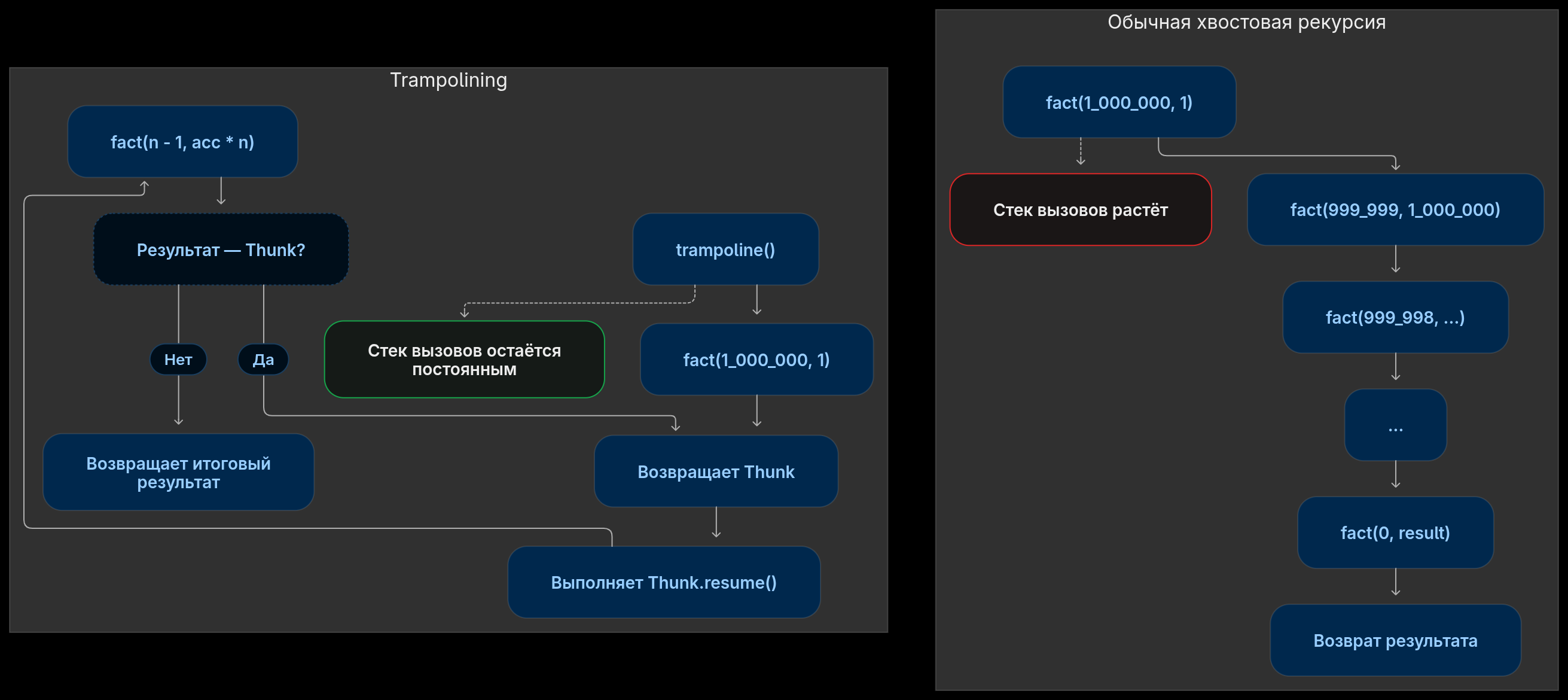
So there is a way to make languages without TCO clear the call stack when it is no longer needed. It's called a trampoline. Unfortunately, it requires changes to the original function:
final class Thunk
{
    public function __construct(public Closure $resume) {}
}

function trampoline(Closure $start): mixed
{
    $value = $start();
    while ($value instanceof Thunk) {
        $value = ($value->resume)();
    }
    return $value;
}

function fact_trump(int $n, int|float $acc = 1): Thunk|int|float {
    if ($n === 0) {
        show('fact trump at n = 0');
        return $acc;
    }

    return new Thunk(static fn() => fact_trump($n - 1, $acc * $n));
}

trampoline(static fn() => fact_trump(1_000_000));
And we see this stack trace:
fact trump at n = 0
  #0 show line 81
  #1 fact_trump line 85
  #2 {closure:fact_trump():85} line 13
  #3 trampoline line 90
that's for the factorial of a million! A reminder that the two previous implementations already OOM'd around 200_000.
PS. int|float in the iterative form is there because on
large numbers we overflow int and the interpreter turns the
number into a float.
PPS. The full code example - https://gist.github.com/4irik/83732a02ea7b6c0b85bf40ab0619aab1
Comments
Comments on GitHub